Day 10326

Spring is here for good; the snow and the ice have melted, and the grass is turning green. As the Woolly Mammoths migrate into Canada, and the glaciers recede, spring meltwaters have started flowing down mountains into the watershed. One of these seasonal streams is flowing over one of my friend's driveways. As a new home-owner, he was less than excited to see that this is what spring brings. We talked through our options, and decided the best, easiest, most cost effective fix would be to remove the damaged drainage culvert, and leave it open.

Nakahla and I loaded up my dad's backhoe, and we departed early for the mountains. Mark lives on quite a slope, so I parked my poor half-ton truck at the bottom, unloaded the Kubota, and drove it up the rest of the way. Mark's neighbors were glad to have an alarm clock chugging up the hill at 8am on a Saturday, I'm sure. Nakahla went in to help Jess with their kids, and Mark and I surveyed the damages, made note of what was working and what wasn't, and made a rough plan for what we'd be doing. When we wrapped the chain around the first piece of 18" culvert with the tractor, I thought I was going to be coming up here for the next month to finish the project. "What have I gotten myself into?" I asked... aloud. "I'm going to be doing a lot of work on your barn!" Mark replied.


Mark's yard had one culvert flowing from the upper driveway, under 30' of yard, and under a lower driveway. We found that the upper driveway's drain was still flowing, just clogged at the inlet, which we cleared. The middle drain had separated and water wasn't flowing through it anymore, which is fine because the lower driveway's drain was collapsed anyway! We dug up the middle and bottom sections, replaced the broken bottom with the intact middle, and crafted a streambed in the middle section of driveway. To keep the lower pipe from clogging we made a small pond full of larger rocks to discourage things from flowing through.


In hindsight, we should have diverted the flow as best we could at the top, and worked from the bottom of the property up. Instead, we were working in the water most of the time. On the flip side, the water flowed where it wanted to go, and softened up the earth around it, making it easier to work. We were able to make small diversions while we worked, anyway. Amazingly, we got the project done in one weekend. Jess and Nakahla kept us fed, Mark's kids kept us entertained, the weather cooperated, and now I have an indentured servant for my next project.


At home, I reattached the backhoe to the Case tractor. It has been sitting plumbed for a few weeks, just waiting for free time and warm weather to coincide. I started the machine up, and back it up to within 6" of the backhoe. I dug the bucket into the ground, and used the dump pistons to push the tractor forward and back, while adjusting the backhoe swivel pedals left and right, to line up on the backhoe boom. I was off the machine for this, so I had large split logs under the main wheels to keep it from rolling. This went really slow, and required a bit of patience, to get two several-ton pieces of steel to line up within 1/2". Once they were close enough, I used the Hi-lift jack to lift the backhoe boom. With luck, and my dad offering a second set of hands, the pin went in without much effort. I then reinstalled my zip-tie color-coordinated hydraulic lines, and pinned the boom cylinder to the swivel tower. I reversed the pressure/relief lines on both the stick and the bucket cylinders so that pulling the levers toward you brings everything in, and pushing them away runs it all out.


A handsome dog.


If you don't have a backhoe, that whole paragraph probably sounded like Chinese. If you do have a backhoe, it probably sounded like Chinese, too. End result? I have a backhoe again. And it doesn't leak from the valve spools. I finished up the project by putting snap-rings on pins, changing the hydraulic filter, and pressure washing the greasy spots. Also, the pressure washer started after a dozen pulls, on old gasoline, after sitting for six months; when does that ever happen?


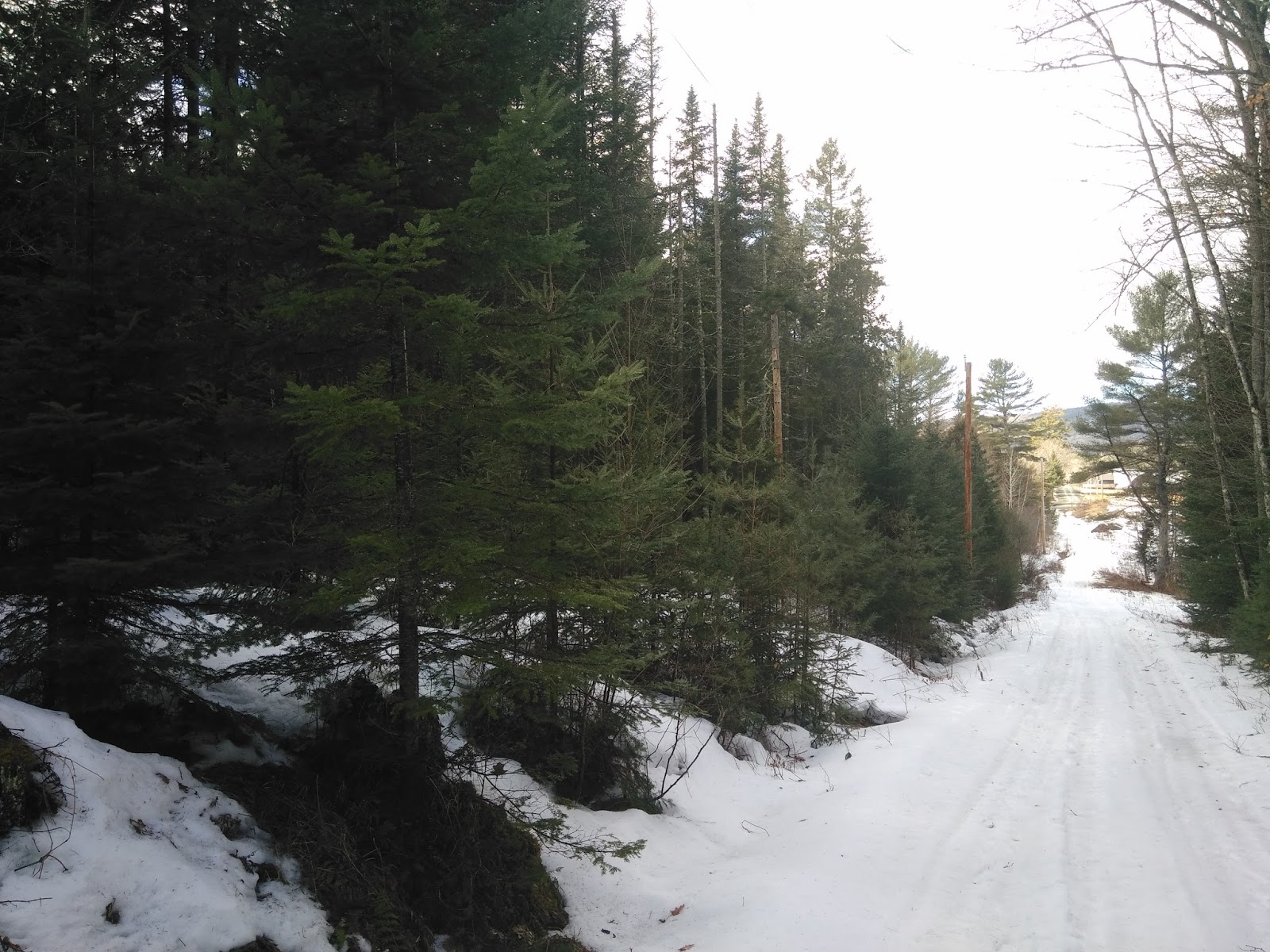
Over Easter, I toured another property up North. It had come up in my search online, and I had discarded it, but Nakahla had sent it to me again for a second look. More than ten acres, fields and woods, a stream, convenient to the highway and close to family, for a price I could afford. I thought it was under a set of transmission lines, but on second look I realized the pictures weren't matching up with the pin on Google maps.


Happy dog.


View to the North.


A bunch of nice Birch trees.


I walked it with my Dad, who approved. I came back later with my Mum and Grandfather, who both approved. Zeke liked it. I liked it! The bus will fit! I emailed my realtor and put in an offer. We'll see how this plays out.

These epic posts, with weeks of work condensed into one write-up, sure make it seem like I accomplished quite a bit in a short amount of time. I can tell you that it feels like I'm dragging my feet, and not able to work on anything when I want to!

Next up is the mounts for the solar panels on the bus roof, some small welds on my dad's tractor and mine, and an oil change on the welder. Once I have everything else in order, I'll start the big project of the dump bed install on the F350.

If the land purchase goes through, I will start getting equipment up North.

Thanks for reading! Feel free to leave a comment or send me an email.

Day 10292

The thaw is coming. The first trees are starting to bud, after a series of snowstorms brought us a second winter. My cabin fever will soon be cured by sunlight and 40 degree weather.

Over the past few weeks I have been working primarily on the backhoe, making a lot of progress on the warm days.


On a cold, sunny day, I took a torch and penetrating oil down to my stuck swivel piston bearing on the old backhoe tower. I knocked the 500lbs of steel off the blocks for easier access, and heated it for several minutes with a gas torch. Using a densely packed snowball, I cooled the bearing. After a few sequences of heating and cooling, I was getting half a turn out of the bolts to pull the bearing out. Once it started going, the stubborn bearing came out relatively easily.


Zeke was less than interested in being a sled dog, so I ended up pulling the heavy, greasy piston up to the backhoe for installation.


 Going for a walk out back was fine, though.


After a lot of cleaning, I got most of the dirt/grease/hydraulic fluid mix out of the tower. I lubricated the bearings with red axle grease (nothing special about it, just something to keep water out) and installed them with fresh bolts and lockwashers. The hydraulic lines to the swing cylinders and stabilizers were all pressure washed, and any with defects (coating worn through to metal fibers) were replaced. 


With the swing and stabilizers pinned and plumbed, as well as the engine oil changed, I cranked the machine over and tested those parts of the system. I made it a point of not touching the middle three sticks on the control tower, as they were just open ports that would have sprayed brown, murky hydraulic fluid at me!


Continuing on, I replaced all the lines leading to the backhoe, and started removing the leaky loader dump pistons so they can be repacked. I'm having trouble with the hardware, which is all (3/4 of the bolts) stuck. Now that my backhoe is repacked and leak free, the loader will be doing the leaking! The Gremlins have migrated. An old Royal Air Force trick was to place first class postage stamps on their airframes; the Gremlins would eat those instead of control wires or fuel lines. I'll have to find out what construction equipment Gremlins like to eat.


Meanwhile, on the F350...


I have to pull some Apollo 13 White-team fix to get a metal fuel tank fuel sending unit to fit a plastic fuel tank. Maybe if I do an orbital sling shot I can get the new unit into the old tank... or use a Sawzall and a lot of sealing compound...

I did get a package for the F350 last week, too.


I bit the bullet on a dump hoist for the F350. It's a Pierce 5-ton electric/hydraulic lift. Not only are they amde in the great state of Texas (with a pump that appears to be from Michigan,) but they've posted install videos on YouTube. Very helpful.


Once the backhoe rolls out of the shop, and the imminent threat of winter storms is past, I'll drop off the plow and roll the F350 into the shop for a dump kit install. I'll also be wiring in soem LED brakelights, and beefing up the existing pintle plate. Still on the search for a flatbed for the one ton.


Nakahla and I went to the Colonial craft show in Portsmouth this weekend. In addition to muskets, ceramics, and tin cookware, was this impressive model of a timber frame house in Rollinsford, with all the pieces labeled.


My dad gave me chainsaw lessons this weekend as well. I'm not too comfortable using the chainsaw yet, but getting better every time. Like any good training event, everything that could go wrong did go wrong. Pictured above is his pinched chain, and my pinched handsaw blade, both detached from their motors and handles to cut our losses. The tree settled onto one, then the other trying to free the first one. We managed to free up both using a wedge and an axe to fell the tree. The chainsaw was undamaged, and we continued with some scrawnier trees! My sawblade was severely wounded in the altercation. Flawless.


Lastly, I toured a property up north with my grandfather. Plenty of room, great location, stream going through it, a spot where I could drive the bus in, and it's in my price range. We'll see where this goes.


Day 10236

Winter's cold has slowed my pace of construction and tinkering on the bus, and the homestead vehicle collection. The panels aren't on the bus roof yet. The backhoe still sits in the barn.


I did, however, install the bench vise that aunt Zowie got me for Christmas. Thanks Zowie!

I did put a bench seat in the truck (remember I picked that up in Massachusetts in the last post?) The bucket seats were more than a little gross, and I think the mice were living in them.


With angle grinder, drill and wrench, I got the carriage bolts out of the cab and pulled the old seats. It was way more fun than you'd imagine. By that I mean it was awkward holding mechanic yoga poses, and my hands were freezing the entire time. I vacuumed the carpet. My mum came over and asked if it was the carpet or the seats that smell like cow manure... good question. This truck has fragrance.


Then the new old bench seat went in ($100 on craigslist, out of a rotten '85 F150.) I dressed it up with a worn-but-classy 1940's blanket I found on Etsy. I cut two small slits for the seatbelts to poke through. 

Etsy is a dangerous place, for the record.

I also bought a hydrometer for the bus's batteries. The cold is hurting those poor things, and it's been too cold and icy for the delicate work of installing the solar panels. Just running the bus once a week to keep the batteries charged isn't enough to keep these deep-cycles healthy; they need a good equalization, or overcharge, which the bus engine's alternator can't provide. The solar panels, however, can provide an equalization charge through the Morningstar charge controller once that system is up and running. All I want is one nice, sunny, 40' day...


The bus wouldn't start on it's own the other day; the engine would turn but the voltage and amps weren't high enough to light the glowplugs, as well. I shoveled and plowed a path down to it, and jumped it with the bed-less F350 (the ride, on the new bench seat, was quite pleasant.)

You may recall that these batteries once powered the bus. The same day I put the bench seat in I changed the truck's battery terminal lugs over to post-type, ditching the beat up clamp-on style. Without the lead adapter pieces on the battery terminals, the hood closes all the way! Hooray, less fire/electrocution hazards! I don't have any pictures of that job because I was cold.

After a full charge, and letting the voltage settle down for an hour, I used the hydrometer to check the bus battery's charge. Each of the individual T105's has 3 cells (a battery cell is ~2 volts.) The battery acid in a fully charged battery has a different specific gravity than that of an uncharged battery. With the hydrometer I found that two of my batteries were scoring in the 85% capacity range, and two were in the 70% range. They need an equalization, but it's going to have to wait until warmer weather and free time comes around simultaneously. I didn't take any pictures because I was working with battery acid... and I was cold.

In the meantime, I've been reading... a lot. I read Gaining Ground, by a disciple/contemporary of Joel Salatin's; Forrest Pritchard. After his parents make a profit of $18.16 off several truckloads of corn and soybeans, Forrest returns from college with the mission of saving his family's farm. Very good read with a lot of humor! I also read through the "Wranglestar" family's book, Modern Homesteading. I've been a big fan of Cody's videos on YouTube, and enjoyed this summary of the family's journey that was mostly stitched together by Mrs. Wranglestar. Now I'm onto Everything I Want to do is Illegal, by the illustrious Joel Salatin. I got to see him this weekend, at a National Organic Farmer's of America conference. As the keynote speaker he gave a talk with many of the themes of Folks, This Ain't Normal. He was preaching to the choir, but I enjoyed it very much.

The land search continues, and I've elected to set my sights farther North, for various reasons.

Day 10207

I struck gold on craigslist; six old Siemens 75 watt solar panels. Not only were these made in the glorious USA, but they have a reputation for durability. Like many things on craigslist, their origins are shrouded in mystery, but I will put them to good use on the roof of the bus.


The gentlemen I bought them from helped me cut the six-wide frame into three sets of two panels, which I loaded into the truck bed carefully with cardboard and blankets to keep them from harm on the ride home. Additionally, I found a bench seat that would fit the F350 (the bucket seats are pretty gross) which was on the way home from southern Massachusetts.

While the Powerstroke diesel in the nose is very good at providing the bulk charge to the battery bank, the absorption charge which completely charges a battery is best done by a tapering power source like solar panels. I have been reading up on HandyBob's blog again for more insight into crafting a solar power system (his writing was indispensable to the design of my electrical system thus far.) I also bought a Morningstar TS-45 charge controller, because HandyBob said so, which essentially feeds the batteries palatable electricity from the panels. I also bought a hydrometer to check the specific gravity of the battery's fluid, which is the best way of determining the health of the batteries. I really should have acquired one a while ago. More on these two pieces of gear in future posts.

There is a surprising amount of geometry involved in setting up a solar system. The goal will be to get all six of these panels on the roof, pointed true south for maximum sun exposure, angled for the winter sun at our latitude, and out of any shadows created by trees or the chimney. The exact location of the panels is still somewhat up in the air, but I think I'm going to put them above the front door, on the passenger side, running back to where the chimney comes out. I will have to accept an evening shadow from the chimney with this configuration, but it minimizes length of cable needed to reach the battery bank, avoiding excessive voltage drop (very important.) We'll see what happens.


For elbow room, and access to a lot of 110v amps, I elected to do this project in the big cold barn, instead of a nice warm bus. The hardware holding the panels to the thick steel frame was very corroded, so I cut the temper-resistant bolt heads off with the angle grinder (clearly not tamper-proof, or I wouldn't have been able to get them.) A hammer and punch knocked the bolts loose, then I picked the frame pieces up off the bolts, which had to be sliced in half again to remove from the thin aluminum frame of the panels.


The aluminum frames had also corroded where they were bolted in. The brown and orange material is rust from the steel frame. The off-white powder is aluminum oxide. Corrosion... gross.


The panels, standing tall on their own, free of the nasty, heavy frame. I neglected to mention earlier that all the wiring linking  these panels together was still intact, and of a proper gauge for my application. More on that in the future (parts are on order.)

With the panels separated, I continued to clean them up, and think of ways I could mount them to the bus. This took some time; I turned to Google and saw a lot of things... some good ideas using perforated angle... and some horrible monstrosities using perforated angle. I personally think perforated steel angle is ugly (and not the good kind of ugly like the A-10 Warthog, Black Hawk helicopter, and all of my vehicles) so I want to minimize use in the final design. 


The panels need to be able to pivot, and be easily adjustable, so that they can stare up at the summer sun, 20 degrees from horizontal, or out at the winter sun, 66 degrees from horizontal. (your latitude +/- Earth's tilt) To do this I am going to use perforated angle as both the interface between the mounts and the panel, as well as the adjustable piece of the mounting system. I bought the metal I needed, and cut my first prototype pieces with an angle grinder.


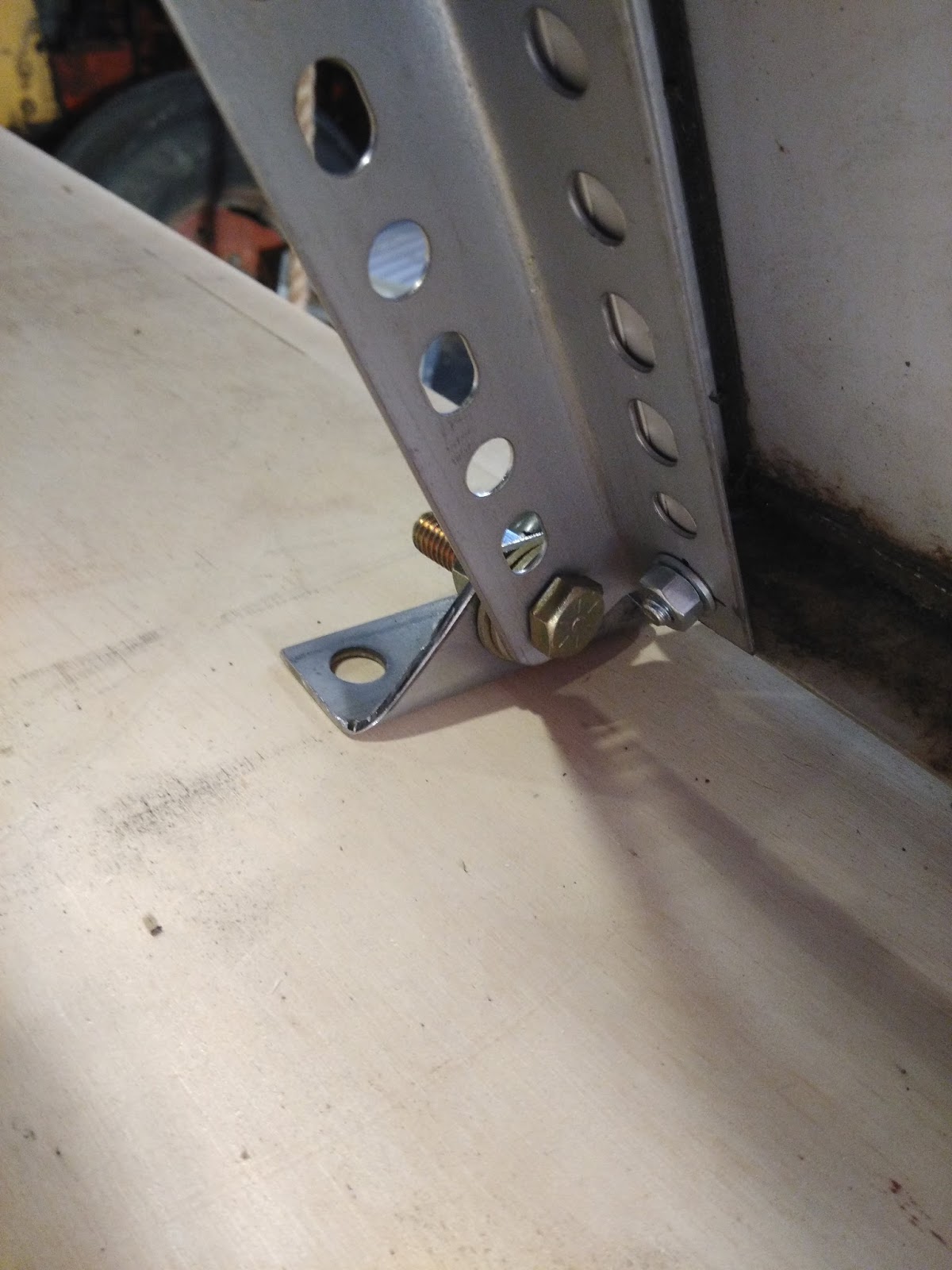
The mount feet are 1-1/2 x 1-1/2 12GA steel angle. The mount rails are 2' chunks of 1-1/4 x 1-1/4 18GA steel angle, with the bottom corner filed round to pivot freely.


Using a 4', 1/4" steel rod roughly bent to shape while cold with a vise, I can make a triangle to secure the panel upright. The rod acts as a spring, pushing out into the holes of the perforated angle, and could be easily adjusted for different seasons. The bottom of the "V" would have a bushing, and go into another mount foot. The angle would also be different on the curved roof of the bus; once the pivot feet are all mounted in line at a good spot on the bus roof, I could come through and position the support rod's mount so that it could adjust between 20 and 66 degrees, and hopefully some kind of stowed position.


With a functioning prototype, I went to work cutting out feet and rails from stock.


In total, I made 18 feet (which is overkill, I'll have extras) and six pairs of mirrored rails. I left Tractor Supply with another $15 bag of 1/4x20 nuts and bolts. Now for the tedious task of removing flashing and burrs with a file... I really ought to get a bench grinder...


Day 10184

I'm stepping it up, slowly.


Though the bus is still parked in the parent's backyard, I have been using it like it is deep in the woods. Every time I'm out here exercising the bus, I'm getting more proficient at living out of it. Tonight I made dinner (a nice dish of rice, peas and scrambled eggs) on the wood-stove, which I started with a single match. I ran the palm-sander and charged some drill batteries off of the inverter. I am composing this entry on my laptop over internet from my phone's data plan. Why pay for phone and internet when I can just pay for phone? Tonight is supposed to be pretty cold, down to 17F by the morning, so we'll see how well it stays warm. Although I'm 150' from the barn, I am self-sufficient. I might as well be on the future property, lounging after a day of milling trees or running the backhoe.

I'm also listening to streaming radio over the bus's freshly wired set of speakers... a few weeks ago my neighbor, Joe, graciously donated his old delivery van's radio set up. He came over and helped me wire it, having done a few before. The bus has six speakers in the ceiling, and I had previously identified the harness which a radio could plug into. I was coming up short finding a radio that would fit the 12-lead plug, though.

Joe pointed out the markings on the wires were relatively standard across the industry, and promptly began cutting off plugs and splicing. Given my background, working on helicopters, I was cringing inside thinking; "But- but- I'm sure there's a wiring diagram out there somewhere!" I should never have doubted him though, as his Yankee-ingenuity and gut instincts led to a successful first trial when we plugged the stereo's aux cord into my phone!

Thanks Joe, Cindy & Tommy!

During a family vacation last week I was able to complete a few books I'd been working on. David McCollough's The Wright Brothers, which was a quick, inspiring read. The drive and determination of the Wright Brothers is admirable; and they did it all on a limited budget. Also completed was another book by Joel Salatin; You Can Farm. Where Folks, This Ain't Normal was a collection of rants about the agricultural industry, You Can Farm is practically a bible, an operator's manual, for how to set up a small commercial farm. The book is a collection of farming knowledge accumulated by one man through hard work, pain and patience. I took a lot of notes and dog-eared many pages. Currently reading Mortgage Free! and Deep Survival.


Current projects;


- The search for land continues.

- Put the fairings back on for the speaker wire harness, and build a shelf for the radio.


- Backhoe tower rebuild, hydraulic flush and filter change, engine oil change, fuel filter change...

- I need a stopper for the kitchen sink; doing dishes out here is proving challenging. Bus-life problems.

The bus is coming into it's own, as well. Like any fuel-drinking, air-breathing vehicle, it has it's own quirks and character. The headlights have always perplexed me, as the switch doesn't seem to have much influence in the off position. The headlights turn on and off as they please. This evening as I was getting the fire going and running the motor to recharge the battery bank, I stepped outside to get a load of wood, only to have the bus illuminate my way up the icy hill! Thanks, bus! Like a Blackhawk helicopter, a temperamental tractor or a Stephen King-inspired gasoline lawnmower, vehicles have souls and should be treated accordingly. My views are similar to those of Tennessee Steinmetz. Thank them for their work, and don't get mad at them when they break (unless they clearly did it to make you angry.) Coming back with a book and some firewood, the headlights came on again for my walk down the hill. Thanks, bus.

Day 10152

Hey, I'm still kicking. After a mission with the unit which took me across the country for a few weeks, I've been relatively busy with work and drill. Now that daylight savings has taken effect, I can say goodbye to after-work projects at home outside without a light-set. In the meantime, on mission, I've been doing a lot of reading and scheming. I think I've mentioned before that missions usually give me a chance to reflect and plan the next stage.

Current projects;

1. Rebuild the backhoe - this greasy, knuckle-busting project has dragged on as I procrastinate and take care of other things. I want it done before snow falls. I need new pins for the stabilizers, and will need a good amount of worn hoses remade.

2. Find land - In addition to having automated searches on Bean Group's website, I have posted a want ad on craigslist outlining my basic requirements, which has netted a few responses. I have been searching for more than a year; this process is grueling! I will hold out until I find something suitable.

Future projects (for the winter;)

1. Fix minor issues on the Case 444 (hydraulic leaks and the like)

2. Re-engine the Case 446 parts tractor, and turn it into a working machine.

3. Go from amateur chainsaw operator to journeyman chainsaw operator by working with dad on felling dead trees

The books I've been reading include Five Acres and Independence, originally published in the 1940's by M.G. Kains, as well as Folks, This Ain't Normal and now You Can Farm, both by "Christian libertarian environmentalist capitalist lunatic farmer" Joel Salatin. I thought this guy was slightly kooky before reading his book (he was the farmer casually cutting chicken's throats in Food, Inc.,) now I've confirmed that he is in fact kooky and I like him a lot!

Folks This Ain't Normal is a collection of essays and rants about the state of our society, agriculture, the environment, government regulation, social norms, and how they are all intimately related. One thing Salatin focused on was the absurdity of the food police in our current era, where a mother selling ceviche online without a license is charged a fine and has to appear to court. The same organization saying that selling un-inspected food is wrong or dangerous, the USDA, is the same organization that says it's safer to trim chicken's beaks, feed ground remains of dead cows to herbivorous cows in a factory farm, and approves of high-fructose corn syrup and genetically modified foods.

The United States has become detached from it's food production. Being a farmer isn't the noble, common, occupation it once was... it is now done by a small minority who are just eking by managing large-scale factory plots. We have become accustomed to having fruits and vegetables out of season, thanks to the petroleum burned to ship food across the planet. We take mothers to court for selling (probably delicious) food to people. I wasn't exposed to this dissonance until my family had food-related issues in the past few years; now I read the ingredients list on everything. I am inclined to believe that the majority of health issues faced by Americans are directly related to the poor quality of food we consume.

I also have a theory that the survivalist movement is a wayward return to a farming homestead. If you really break it down, a farmer is the ultimate survivalist. A farmer has everything he needs to not just survive, but to thrive on his land. There is no need to have a bug-out bag or bug-out vehicle to get to your bug-out location (which everyone else is probably headed toward anyway) when your homestead has everything you need.

Stay tuned; hopefully we'll have the backhoe up and running over Veteran's day weekend. Maybe I'll buy some land.


Day 10111

Over the past week I've closed a lot of loops and finished a bunch of small projects. I'm running out of things to do on the bus! Last week I spent a few nights sleeping in it, and found it to be very comfortable. Most of Day 10109 was spent in the bus, cooking reading and doodling. Good lounge day.

I'm skilled at procrastinating something I don't want to do, and accomplishing a lot in other areas. Lately I've been putting off the backhoe rebuild (a greasy, knuckle-busting job) in favor of cleaning up the barn before winter and getting rid of things I don't use or need. A few large bins went to the Salvation Army.

A quick after-work project was replacing the worn-out batteries on the F350 with the bus's old batteries, which was brought on by the truck not having enough power to get started the other day. I had intended to replace the old beaten terminals on the truck's battery cables, but the project proved to be quite daunting, and I elected to not fix what wasn't broken. With the assistance of a set of channel-locks used as a hammer, I got the beaten old terminal ends over the new battery lugs. Whatever.


She lives! The wire harnesses were neatened up as well as I could; they're a mess from the cab swap. I also noted the starter solenoid is a massive blob of rust, and imagine that could be the source of it not starting from time to time. I'll replace that when I find some motivation. Fun fact; the new batteries are a little taller, and now the hood doesn't close all the way! I can still get one dragster pin's hair-pin in. Good enough.


Meanwhile, in the bus, I neatened up some of the DC accessory connections...


... finished another little light's mounting bracket...


... and installed the trim piece I had removed from the fireplace in front of the cabinets.


Saturday I cut some scrap siding into little triangles, and used some aluminum bar stock to make much needed book-ends.


I painted the bookends with leftover bus paint as little mountains. Now my small bus book collection is a miniature mountain range. 


I took a piece of Maple I had purchased a few weeks ago, and made a coat rack with a bunch of cheap cast-off (i.e. they still do their job but they aren't as pretty) Shaker pegs. The pegboard was installed in the mudroom; also known as "the staircase" or "the area immediately to the right of the driver's seat," if you want to get technical.


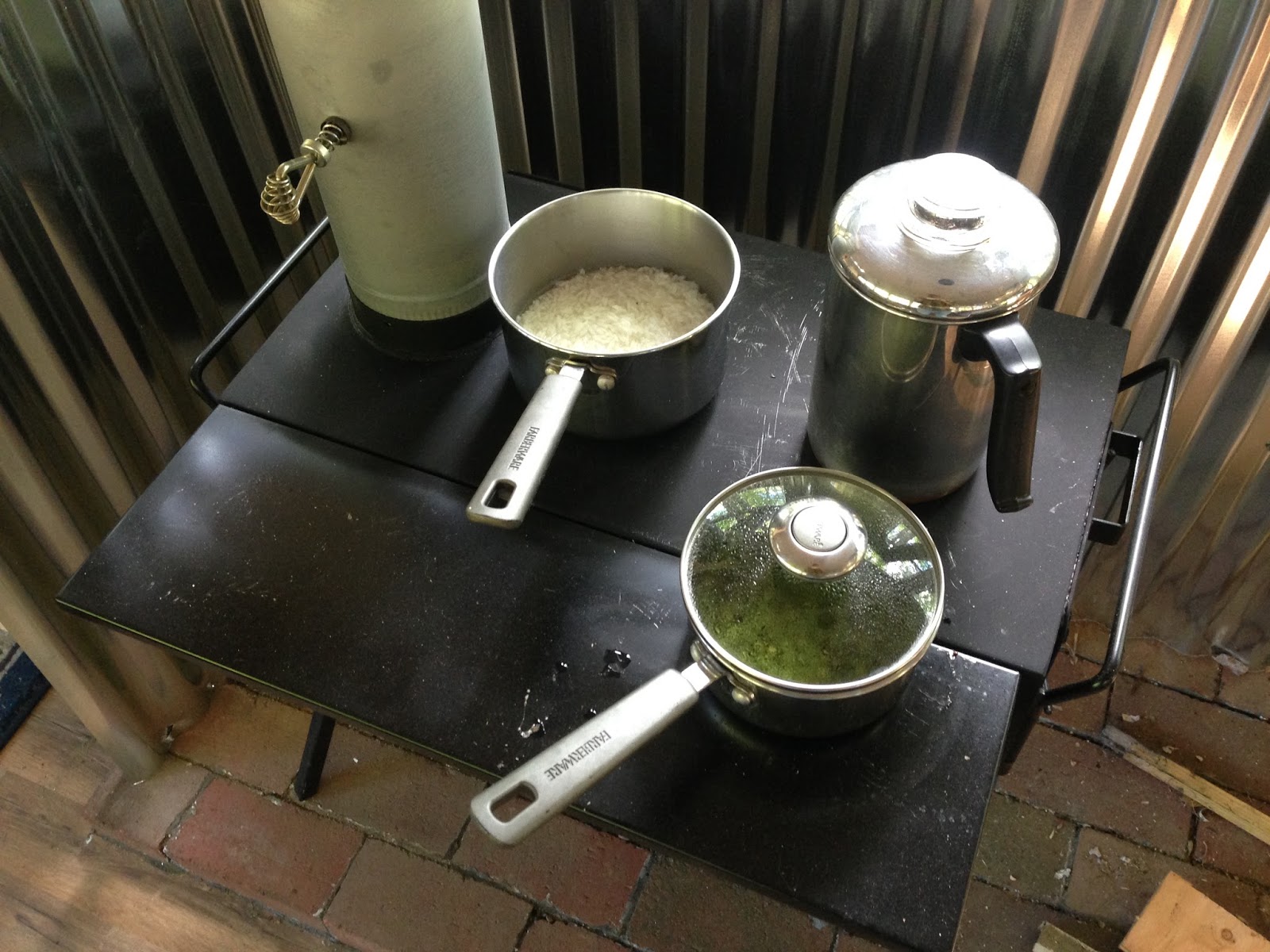
Break for lunch; rice and peas on the wood-stove, with some re-heated percolated coffee. Mmm.


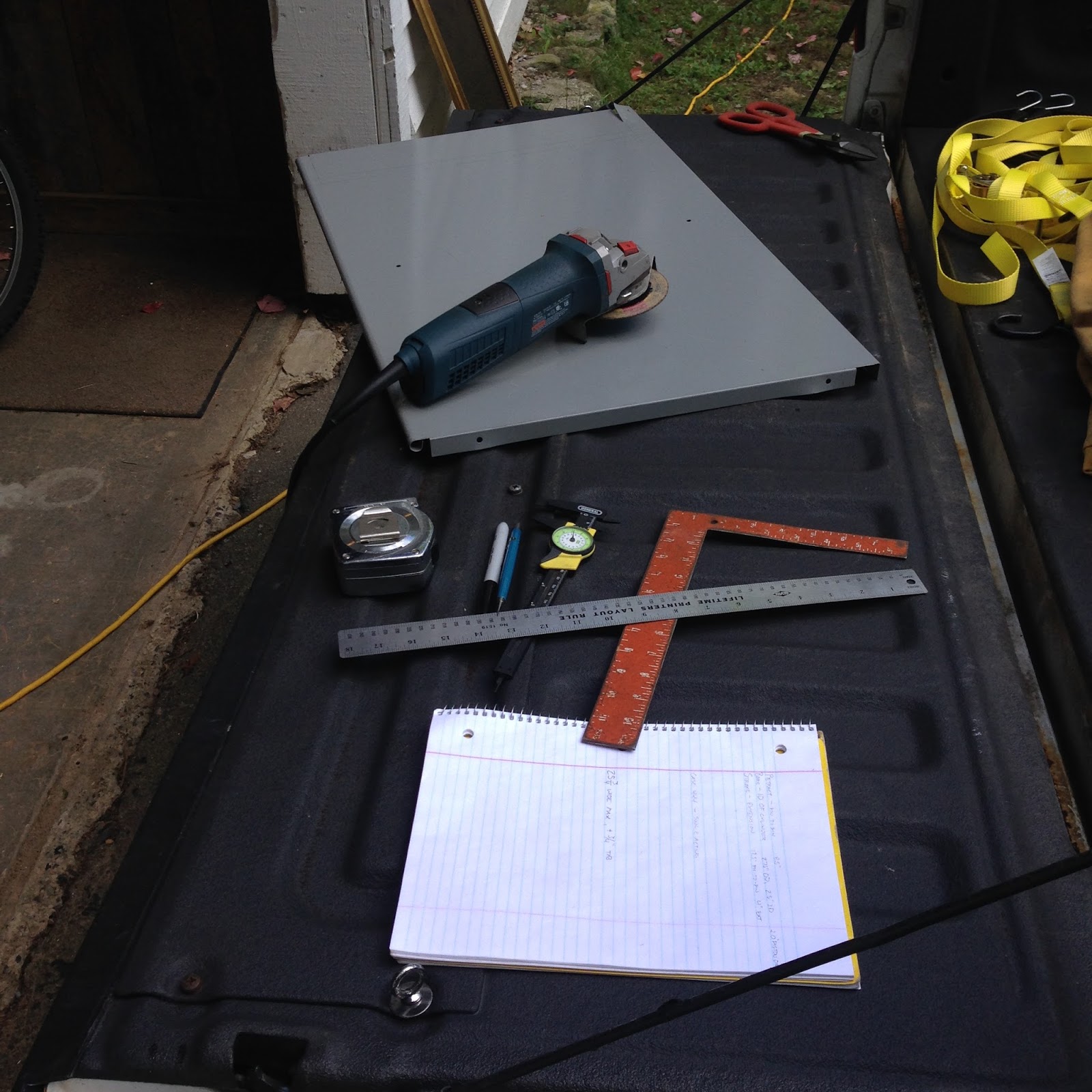
Then on Day 10110, I took on the metal panel for the chimney's window. This piece will serve several purposes; it will be a structural support to the chimney hanging out the window, keep the rain and snow from getting in, and keep the warm air from getting out. I also wanted to make it in such a way that removing it wouldn't be a nightmare (so nothing too permanent.) My starting piece was a steel shelf, acquired surplus from a certain government building's scrap metal bin. The shelf had 3/4" tabs that I wanted to retain, as I could inset the piece into the window's recess in the bus's sheet-metal. 


After some measuring, guesstimating and eyeballing, I drew out what I needed on the piece, then cut it to shape with the angle grinder. See the new 3/4" tab?


Next I bent my new 3/4" tab up. At work we have a large tool to do this quickly. At home I have vise-grips and patience.


My piece cut to shape, I measured the top, bottom, left and right limits of where the stovepipe wanted to sit, coming out the window. The pipe has a five inch diameter, but climbs out the window at an angle, so the up-down measurement was closer to six inches. I used the four inch hole saw to cut out the center, then finagled the tin snips into the hole to cut twelve tabs all the way around.


In a technique that I unabashedly stole from the Splitting Elm blog, I bent the tabs in and out, mounted the panel into the window-frame, then screwed the pipe into the hole. I like how they did this. I got lucky, here; it fit without much adjustment.


Finally, to literally top it all off, I found a sharp looking cap on eBay, made in Maine, USA. It arrived yesterday, and I installed it after work today. Four feet of stovepipe past the exterior elbow gives me enough draft that I'm not filling the cabin with smoke when I start a fire, AND no longer setting off my smoke detector, which seems to be a slightly louder version of the INCOMING alarm at Jalalabad.


I'm really happy with how this came out. What used to be an oddly painted bus with furniture is now clearly a small home.