Showing posts with label land. Show all posts

Day 10994 - Big Ben and the Thomas Sawmill

I have been a horrible blogger. In the hustle and bustle of activity, I have stopped writing. For anyone wanting to blog, I recommend making writing part of your routine. For me, the writing process helps me digest everything I've done, and allows me to think about accomplishments in a different way. With this fresh perspective I become a better decision maker, and paths to reach personal goals are clarified.

The next few posts will all center on specific accomplishments, and I'd like to shift my writing style to that, by focusing on places, projects or events, instead of jumping around like I have been. While this is chronologically accurate, and shows the realism of finding time and energy to work, I think it's a bit harder to follow.

The first story, told in hindsight after many months, is of Big Ben and the Thomas Sawmill. Last year my friend Gavin had me come over and help him clear a few small trees, then dice them up for firewood. This was a good amateur chainsaw operator project. While cutting the trees, I was enamored by the massive Great White Pine in Gavin's backyard. The tree was enormous; splitting into four major branches, each the size of your typical central NH tree. I told Gavin that if he ever wanted some cash, to let me know, because I would take the tree down and turn it into a barn. Gavin, being the nature lover he is, politely refused. He had named it Big Ben and it was a proud feature of his backyard.

Several months later, a strong squall line blew through, taking many trees down. One victim of this storm was Big Ben; two of the four massive branches fell in the storm. Gavin called me, asking if I could help him clean up the mess made by the big branches. Travis and I set to work cleaning up small branches to assess the trees, and found a pair of poor man's ship's masts. There were a few small crooks in the wood, and they had broken in several spots from the impact, but we were looking at a lot of healthy lumber.


Gavin wanted live-edge slabs for tables, and a cleaner back yard. I wanted beams for barns. I called my dad for a sanity check, rattling off dimensions of the logs, and asked if it was time to buy a sawmill. His reply; "Son, it's time." Knowing that both Gavin and I stood to gain from this deal, I loosened the purse-strings and turned to craigslist. I found a reasonably priced Quebec-made PTO chipper for the Ford 1700 to mince up the smaller branches. The chipper did this admirably. We found that it would cut green pine limbs the size of your thigh, and dead pieces the size of your arm.


While we chipped away at the branches, literally, I called Thomas Bandsaw Mills in Brooks, Maine and ordered a Mill. Reviews I had read online said they were solid and simple, the 6013 model (now known as a "2413") hadn't changed in 20 years, and I found that the prices the used mills commanded on craigslist were the same as the price new. Wanting something I could tow around and set up anywhere, I ordered the 6013 with a reinforced track and trailer kit. It would be ready for pickup in three weeks.


With the 1700, a chain, and some logging tongs I readied the knotted tops of the trees for my first attempts at milling. At home I watched youtube videos for good techniques to avoid wasted time and wasted material. By the time I got down to the sturdy bases of these branches, I wanted to be somewhat proficient.


Watch out for the Robin's nest while skidding logs!


At the end of June, the Mill was ready for pickup, and Gavin towed it into a clearing in the woods with his Kubota, meandering around trees. We left the axle on for the first few logs, leveling the track using the yellow struts, a farm jack, and the tractor's bucket.


The first few logs could be picked up with the tractor, and driven on.


Once the logs were dogged, we could begin passes with the mill. Some sources online said the bark would dull the sawblades faster, but given how cheap it is to get blades sharpened, I elected to save the time that would have been spent debarking and convert it to higher operating costs for less time.


The first two cuts are made to make a clean 90' angle out of the log. I cut down in 1" or 2" increments, so that any boards cut during this process could be resawn later, reducing waste.


After the 90' cuts, the log can be secured with the small hooks in the bunks, and the dogs set low, so the mill can go all the way down to 1". here is a 6x6, 2x6, 2x4 and 4x6.


The sawmill's field site. Logs get loaded on the sawmill trailer's "left side" and the mill's tower is walked backwards through the log by the operator on the left side. The pallet has tools, oil and fuel for the mill, chainsaw and equipment. One day I'll make forks for my tractor so that's easier to move, and logs are easier to load.


Our first products! The stakes separating the lumber for drying are a natural result of edging boards, and cutting a timber from the log. The live-edge slabs were "three man" lifts, and a fourth would have been nicer! Heavy!


As we went down the tree, taking logs from top to bottom, the tractor couldn't lift the progressively heavier logs. To facilitate loading, we took the mill off its axle, bringing it as close to the ground as possible. Using nylon straps with loops on both ends, as well as the chain on the bucket's hooks, we could lift the log evenly and position it where we wanted it. Final adjustments were made with a farm jack, or a 2x4 lever and some patience. One of the great things about having the mill, and a chainsaw, is the ability to make whatever wood tool you need for positioning logs!


This 16' behemoth, 30" across, barely fit on the mill, barely fit under the tower, and the tractor was barely able to load it by pushing alternating sides. A pair of purpose-built loading ramps would be useful.


This piece yielded six 16' 6x6 posts.


Maintenance on the mill was easy enough, although it did have the "expected" unexpected growing pains and a few learning experiences. Letting off the forward pressure with the blade turning through a log is a good way of pulling the blade off the wheels. The two adjustment guide rollers on the bottom of the tower, that are left and right of the blade passing through the log, have nylon bushings that wear, loosen, and turn, jamming and ruining blades. Above, Travis mounts a fresh blade on the mill.


This was my overnight fix for the jammed guide bushing. I cut two pieces out of nylon sheet, glued them together, then sanded the new bushing to fit the curve of the steel angle. A single countersunk screw, which had deformed, holds the bushing in. Eventually I'll replace the left-side bushing with this design, but it is holding up better than this right-side bushing did. The challenge with this was making it fit right when the bearing gets installed again (notice the top layer of nylon was trimmed back in the third photo.)


With the logs finished, the mill was set back on it's axle for the trip home.


And the lumber was loaded on the parent's trailer for the trip up to the north country. If only I had a deckover trailer and some bucket forks...


Up north, a nice dry site was mowed for the stack of lumber to slowly air dry, and with the help of my mum and grandfather, we unloaded the trailer, and stacked everything by size next to the bus.

All told, Gavin, Travis and I were able to mill more than 1200 boardfeet of lumber, over five days of milling, out of the half of Big Ben that came down in the windstorm. These beams will undoubtedly be used in construction of a home up North, and have sentimental value knowing they came from my friend's land. How cool would it be to visit you friend's house, and point to wood that came from your own land?


Day 10626

Since last post I have spent a few weeks in Pennsylvania, a few weeks in Virginia, and now I'm back in Pennsylvania; all for Army schools. One of the road trips turned into an odyssey; engines refused to start, patience was tested, the go-bag and boots were utilized, foreign foods were tried, and much later a chicken was murdered by a friend.

To start us off, my venerable F150 is showing it's age. In Pennsylvania I heard a BANG followed by  the snap of compressed air in time with the engine. The engine was making a decent side-to-side vibration. I thought I blew off an exhaust manifold. I opened the hood to troubleshoot, and the problem wasn't immediately apparent. I wasn't getting any codes on the Scan Gauge, reinforcing my thought that it was exhaust related. But why do I smell fuel? Everything appeared fine... all the spark plug boots were installed. I called around to find a shop to fix an exhaust, and with a buddy in his car to follow me on a noisy trip, it finally coughed up a code for #3 cylinder misfire. A-ha!


I popped the hood one more time, and found the spark plug still sitting on the top of the engine (two inches right of the bright flashlight spot; see the ceramic?) The engine had ejected the plug from the aluminum head, tearing the threads out.  The spark plug boot dropped back into place. That's why I had smelled fuel. A quick google revealed this as a common problem with the Triton V8's. Next call was for a flatbed, and another call to a nearby Ford dealer. After a helicoil install, my truck was back on the road. The Ford Dealer got my travel pay.

Telling this story at work, Ed the former-Ford mechanic told me about some of the other common problems with my model year. This conversation would haunt me days later, hundreds of miles away. Driving to Virginia in the rain, my engine died in Delaware on Route 1. It would eventually restart, run rough, and die. I called AAA.


On a Sunday afternoon, the only open shop nearby was a PepBoys. The truck started, and the test drive was fine. A crusty mechanic with a cigarette hanging out of his mouth told me it was the catalytic converter clogging up, choking the engine as it got hot. Here's some zen; vehicle maintenance isn't cold logical diagnosis, it involves a lot of feeling and establishing a relationship with the vehicle. How did it stop working? How has it been acting? What were the conditions? The person operating the vehicle knows these conditions and feelings better than anyone. A good mechanic knows what questions to ask. It wasn't running rough; it just died. I had air, I had spark, I had crank... it must be the fuel. But again, I didn't have a code yet. PepBoys wanted to cut the welds on the catalytic converter, but they wouldn't be able to weld it back together until the next day. It was now running fine. The rain had stopped. I asked for my keys back and kept going South.

An hour later it started bucking occasionally. It had started raining. Finally it died again, and I pulled off to the side. I gave it 15 minutes to sit. In that time I put my phone up as a hotspot, and used my laptop to look around the area. I was three hours from my destination, and at this point, exhausted. There was a town 25 minutes west with a Ford dealer and a motel within walking distance. If it started, I would keep going. If it didn't, I was calling it a night. I called home, called my platoon sergeant, called the school. After a good wait, I tried to start it... the engine caught, ran rough, died, and gave me a code! Low fuel pressure. I called AAA, again. Lenny and Debbie gave me and my disabled steed a ride to Salisbury, MD. We talked chicken farming. Lenny even gave me a ride to the motel; what a guy!


So there I was; down to my boots and my backpack in a random eastern shore town in Maryland. I checked into the motel, then hoofed it back to the dealership to get food, coffee and a change of clothes from the bags buried in the back of the truck. Like Spaceman Spiff ship-wrecked on a deserted world, I took stock of what I had. Google revealed the only places to eat within walking distance were food-tainment (you know, I can microwave my own food for a lot cheaper) ... except an Indian & Pakistani restaurant down the road. Had I had it before? Nope, but I liked some of the Afghan dishes! I set out on foot. I got some rice and vegetable dinner that was very good despite being full of curry. I enjoyed a conversation with the waiter, who was NY-born and Pakistani raised, about travelling and eating food around the world. I passed out around 7:30pm.


The dealership rolled my truck in the next morning. I set up camp in a lobby blasting classic rock hits that put you in a car-buying mood. The dealership replaced the fuel sender (which is what Ed told me to check out several days prior,) and I was back on the road. The Ford Dealer, again, got my travel pay. The fuel sender, located above the spare tire, rots out on these trucks and exposes the circuit board to the elements. When it got wet it stopped working. What a great design. I would not buy one of these trucks again. I wouldn't buy anything with a computer "smarter" than a pocket calculator.

If I was to make the curriculum for the aviation maintenance courses I was attending, then coordinating the repair of a vehicle in extreme conditions far from it's support base, while still accomplishing the mission would be one of the most important things to know. I'd like to think I crew chief'ed the situation quite well.

These two adventures, and three tow-truck rides in a month's time, have encouraged me to step up my search for my next vehicle. I need a pickup, but after reading Mr. Money Mustache's article "What does your work truck say about you?" I want to go down a size for something with better mileage. I also want something I can actually work on, not something designed for a dealership. I may have found that truck here in Pennsylvania, we shall see.

While in Pennsylvania, Tyler of Kentucky and Caleb from Ohio and I attended the Farm Show in Harrisburg. This was a huge event. I saw more people in that building that afternoon than I had seen in all of New Hampshire over the past year. The vendors didn't disappoint, and we left with lots of good food. I have a nice hand-made birch mixing spoon for the bus, now, too.

In Virginia I went to Williamsburg, which allowed me to escape the suburban sprawl of Hampton Roads, and walk around a nice New England-esque town and smell the sweet smell of woodsmoke. I paid attention to how the buildings were constructed... how the timbers were set, how the trim was laid, and where the chimney was (keeping in mind that English style woodstoves are usually very inefficient.)

The day before I got home, Roy Orbison the rooster was mauled to death by my cute, cuddly, and otherwise harmless Springer Spaniel. My domestic untrained bird dog really likes killing my domestic birds... Roy died protecting his flock. Luke at work had asked if I wanted one of his roosters several weeks prior; I texted him back to find out he had lost most of his flock to a wild critter.

If any aspiring chicken farmers have recently lost a chicken to a predator, and are wondering when the pain and sorrow will end, I can tell you that after losing your seventh chicken the reaction is about 1% of the emotion invested into the first one. I liked Roy the rooster... but I'm also getting used to chickens dying very easily. Did I mention none of the new hens have names? Much easier this way. Working with Zeke to increase discipline around the chickens.

I went to craigslist and found a free bantam rooster in need of a home, after it's hens had been taken out by a possum. Apparently possums, known for playing dead, also kill chickens. The family I got him from had small kids who named the rooster, appropriately, Woof.


Woof, being a cool customer, and possibly the friendliest chicken I have met, got a ride home in the front seat of the truck, in a cardboard box. I introduced him to the hens thinking they would love a new friend, and was quickly appalled at the law of the jungle in an 8x8' wire enclosure. The hens had poor friendly Woof bleeding and hiding in no time.


I separated them, and with the help of Mom, built another coop enclosure off the back of the run, where Elvis "Woof" Presley could heal up and not be hen-pecked to death. We used a tarp, a pallet, dog food dishes, and a particle-board cabinet turned on it's side. He got his very own roosting stump and branch.

In the barn, I'm working on cleaning up and inspecting the solar panels. Much more to follow on that in another entry.


Zeke and I took a much needed trip up to the land on a warm afternoon. There was still a foot of snow on the ground, and it was about 50'F and sunny in the way that a plaid shirt is the only extra layer needed. Both the bus and the backhoe started right up after sitting for more than two months. I'm equally impressed that the ancient diesel in the backhoe with no glowplugs, and the modern Powerstroke diesel in the bus with all the computers, both started!


In town, my grandfather showed me around Dave's sugar house, which he had helped build. He explained to me how the foundation was poured, how the walls were built, and how I could do something similar. The design is coming together.


Zeke and I went for a walk, then lounged out on the futon for about an hour. I forgot the mousetraps. 

Day 10522


Last weekend's tropical storm knocked out power in the city for a few days. Pictured above is about ten trees blown over, including two large white pines and an oak, which flipped up a bridge on the nearby hiking trail. 


As mentioned before, I was missing the bus's off-grid conveniences during this grid-tied power outage. In the barn I have propane heat, but I couldn't cook without electricity. Thankfully, my truck bed doubles as a field kitchen. Toast & eggs, or tea? Anyone?


The North country had received it's first dusting of snow on day 10520. I didn't see anything taken out by the gusty wind, but the bus had a few leaks inside from all the rain hitting the hatches and the chimney. I think it will survive another winter!


It was still below freezing, so first things first, I cleaned out the woodstove in order to lay down some firebrick. I must have measured wrong, because I could still use a few bricks! These bricks will absorb heat from the fire, slowly, and radiate it out the same way. The bare steel of the stove radiates very quickly.  Hopefully this will make for longer burns overnight.


Zeke supervised the unloading of the 444's new rototiller.  That was heavy... I didn't drag it far.


While the bus warmed up, Zeke and I took a walk out back. 

I know from some research, and the stone walls and barbed wire, that the plot used to be a dairy pasture. I also know that there is an abandoned, grown-in road at the northern edge of the property. Since there were no structures or foundations on the southern edge, I had a hunch that one might lie along the old road...


As soon as I crossed the old stone wall of my land, onto the abandoned road, I spotted two wicked looking old apple trees. People used to plant fruit trees near their homes, and sure enough, a stone foundation lay next to the apple trees. The last time I was out here the woods was thick with green vegetation; I was probably standing right next to it and didn't even know!


I imagine there's more of these foundations up and down the road.


Heading back, Zeke found what appears to be a deer's leg bone. He was very fond of his discovery. 


The winterization of the bus is about done; it should weather the next character-building season alright. The firewood I have on hand is all still a little wet, but nothing will fix that except time in the sun. I haven't even started the dump kit install on the F350, so I'm still without a plow truck for the winter... unless I throw the chains on the 580's tires, and run the generator for a few hours to warm it up! More likely, once the snow gets deep, I'll be hiking in with snow-shoes. With luck, the next few visits up north will be to camp out, cook food, and hike the area.

I'm going to go out on a limb here and say that I have colonized the land in the housebus, and strike that from the to-do list. If the bus can weather another New England winter at the new site, and I'm at the point where I could just go up, start a fire, cook lunch and read... I think it's fair to say I've established myself up North. My next big focus will be picking a site to build, gathering materials, creating building plans, and getting the paperwork in order to start construction in the spring.


Day 10492

Zeke and I spent a much-needed cool morning up at the bus. The fall foliage is past peak on the land, and the wind has taken most of the leaves from the trees on the edge of the pastures. The goldenrod, which was bright yellow at last visit, is now brown and dropping seeds.

Hopping out of the truck after a foggy drive North, we opened up the bus. I grabbed my water bottle and rifle (I haven't forgotten about that bear!) and we set off through the woods. Most all the leaves are down, really opening up the space. We checked a few spots to see if they were still wet, or if they're just seasonally damp spots. The stream was down a bit. Not much wildlife, though we did see a bald eagle soaring above us. 


Made a new firewood pile at the back door, where these oak limbs can catch some sun. I'd like to get some clear plastic sheet to keep the water off of the firewood stacks.


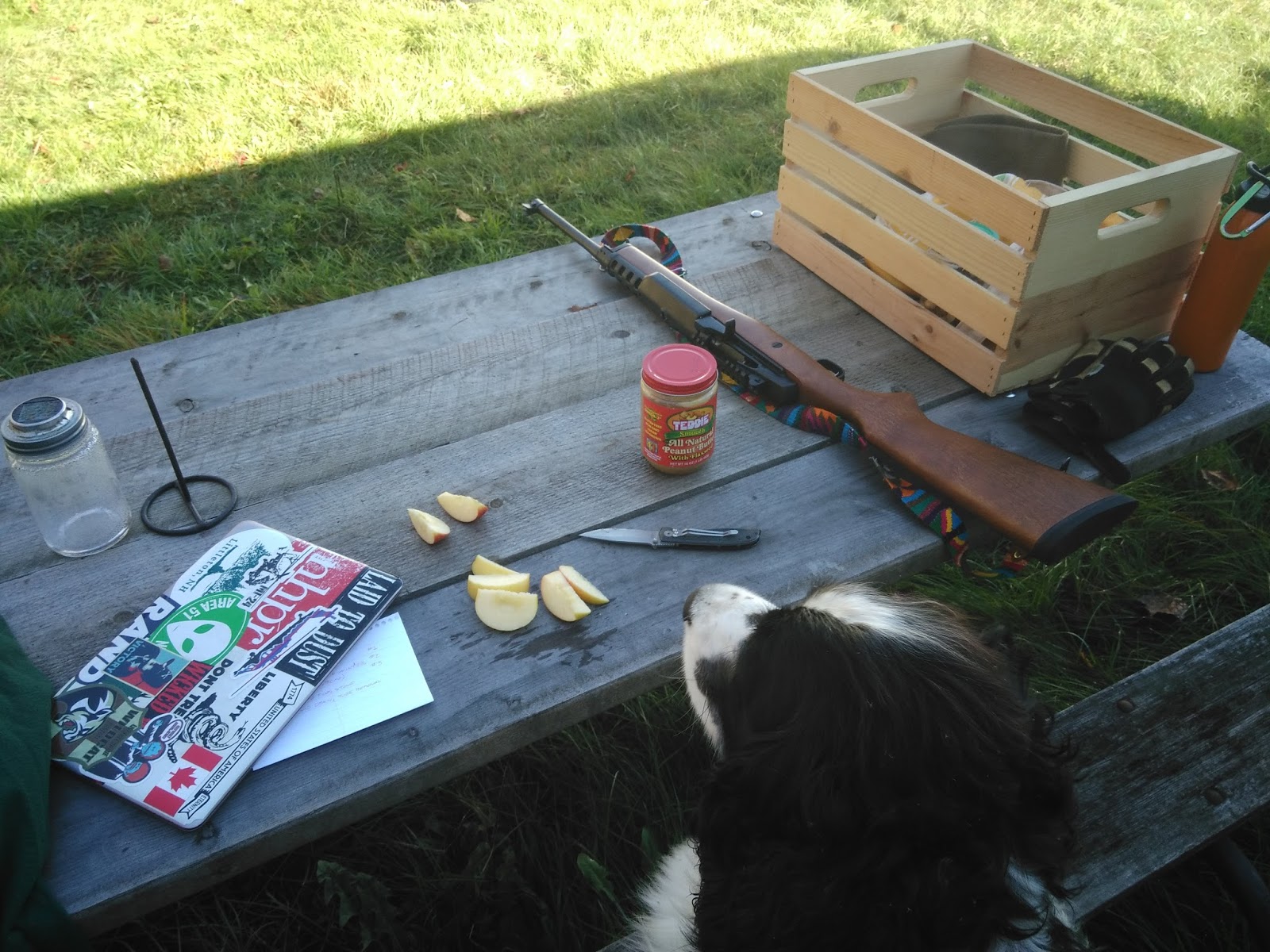
Snack time.

Today's tasks mostly revolved around winter and angles. The first project was the solar panels. I climbed up on the bus roof with a wrench, a small level, and a speed square to change the angles. Two bolts hold the mount to the perforated angled rail; I removed these, brought the panels up to a higher angle... and realized I didn't know what angle I was setting them too!


I whipped out the phone, searched for this blog, found the post where I talked about the panels, and found my answer; line of latitude plus axial tilt of the Earth. So I needed these panels to be ~68 degrees from horizontal. Putting them five holes back from the furthest "up" position gave me 67 degrees. I threw the bolts back in, and snugged the nuts down. With this adjustment, the panels will receive more sunlight over the next six months as the sun travels on a lower arc around the southern horizon. Some call this winter.

Next I took a 4x4 post, a square, and my long level, and started measuring the ground. I want to find the average slope of the land, so that over the winter I can work out a barn design to build to. I set the 4x4 on the ground, with the level on top, and raised the downslope end of the post until it was level. I measured the elevation with the square. After taking half a dozen samples, I averaged them together, and found that the field around the bus drops off about 5.5' vertically, every 100' horizontally. This is a 5.5% slope, or about 3.15 degrees.

My final project is a very specific guesstimation. I want to know about how far the trees on the southern edge of the fields cast their shadows, and how tall the trees are. To find out how tall my trees are I used my pace count from basic training, and the internet.


From the base of the trees, I paced 75' to the edge of shadows. This was at 11:50am, 13 October 2017, at latitude 44.3 degrees North, 71.8 degrees West. I plugged this information in at a calculator found after a quick Google search; Sustainable by Design's solar angle calculator. The angle of the sun was about 37.53 degrees above the horizon.

I drew out a picture, and plugged in what angles I knew. The tree to the field is 90 + 3.15 degrees. The sun coming off the top of the tree is 90 - 37.53 degrees. The distance from the base of the tree is 75'. With these three pieces I can find the other pieces of my triangle. Instead of doing it out by hand and cell phone, I found another calculator through a Google search, triangle-calculator.com.

I found that my trees are mostly 53' high. I have a few that are around 64' high, but it's mostly hardwoods that won't have light-blocking leaves in winter. After playing with the calculator, and using the 21 degrees of the winter sun, I found that these trees will cast shadows 161' back from their bases at noon on December 21st (winter solstice, when the day is shortest, and the sun is lowest.) So if I want a reliable passive solar house design, I can't have my solar heating design elements in that shadow range, or I need to cut down some trees!


Winterization will likely continue with the next visit. I'd like to add some mortar to the bricks under the fireplace, to keep errant sparks out, and get the side windows all closed up (right now they're all one latch down from the top so heat can escape.) Bus and backhoe started right up today, despite the cool temperatures overnight.