Day 10366

Another step of "the Plan" was crossed off this month. I made an offer on the land described in the last post, and after some negotiation, it was accepted. Having closed, I am now the proud owner of some 20+ acres of old dairy pasture and mixed forest.
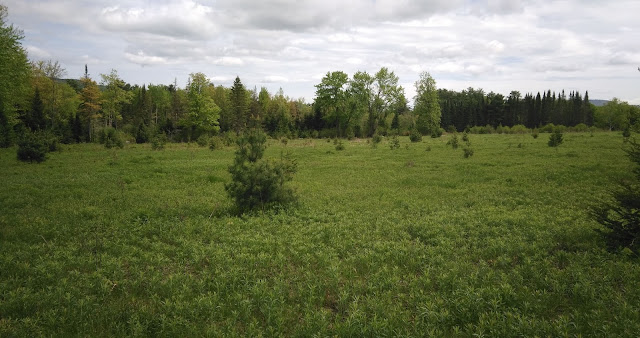

My search criteria didn't seem complicated; I wanted more than 10 acres of land, and I wanted it for less than $100,000. I wanted a water source, a variety of wood, and some fields would be nice. The workable parcel ought to be close to family up North, or close to work down South. A compromise would make for a long commute over the next few years and lack of family nearby (less than ideal.) Ultimately, I decided to trust my gut and buy up North in the mountains and hills, and not in the South, which is growing busier and more congested by the year. I must have toured two dozen properties over the past few years... possibly more that I've forgotten.

The biggest thing I learned was that there is a reason that cheap land is cheap. Fifteen minutes on Google can save two or three hours of driving, burning gas, and hiking through the woods. The terrain feature on Google Maps saved me from ascending many cheap cliffside properties, and helped in identifying such infrastructure as highways, high-voltage transmission lines, waste treatment plants, snowmobile trails, and even power substations. Ultimately, I did find land that was cheap for a reason, but for a reason I would be able to tolerate for the price!

I figure that the more workable land I get for my dollar will save me, later. On a 5 acre plot, I would not have enough trees to build a home, and heat it with wood from the lot. With 10 acres of land that becomes more realistic. Being patient and finding enough land would save me down the road in buying outside resources.

My search parameters changed as I learned how to search for property, through trial and error. One plot in Canterbury had everything I was looking for, but I learned that the rules for buying land were different from those of home-buying. I couldn't afford the $150,000 land purchase without a significantly larger down payment than an equally priced home, which would take a few more years of saving. I lowered my "maximum price" to $100,000. Not only was this a better financial decision, but it trimmed my list of candidates down to something more reasonable. I also found a map from 2009 with every town's property tax rates, which, even if it is slightly outdated, provided a handy guide for which towns I didn't want to pay to live in!

I'm thankful that one of my pilots was my realtor; someone that understood my slightly unorthodox needs, and was patient through the search. He was happy to send in my offers which included owner financing. Sadly, the former owner did not accept my offer, and a bank will be making the thousands or dollars that he could have made. Now the name of my game will be paying off the mortgage as fast as possible to pay the bank as few of my dollars as I can.

The amount of interest I'm paying, the rates of the loan, and the terms of the loan are another rant entirely. My goal here is to pay off the land quickly, and return to a debt-free status while still having enough cash on hand to buy and build as needed. I find the banking system doesn't like to deal with a land purchase of this size. I asked my bank of choice for a 10-year fixed rate loan, and they wouldn't do it (good credit, money down; won't do it.) And yet, as long as you secure a loan with no prepayment penalty, a 20-yr loan can easily be made into a 10-yr (or even a 6-yr!) by paying against the principal. You just don't tell the bank that you're going to do that. I don't feel like I should have to hoodwink a bank in order to get a reasonable loan. The former owner was seeing traps in owner-financing, despite the assurances of both realtors, and the bank wants their interest. Trust is hard to come by.

What a lame post, huh? No pictures.


This is my buddy Gavin's new tractor, a beautiful 1971 Massey Ferguson MF-20 Industrial Loader (we think!) It was generously handed down to him by his grandfather, David, who gave us a tour of the family's farm in the White Mountains. In the coming weeks Gavin and I will do the maintenance to get it running again, and trailer it to Gavin's house.


I finally got the solar panels mounted on the roof of the bus, after five months of waiting for a day off without rain in the forecast. Wanting a nice even line, and a low profile, I used a square to measure 18" from the "rail" of the bus roof, and drilled the holes for each mount one at a time, as I mounted the panels.


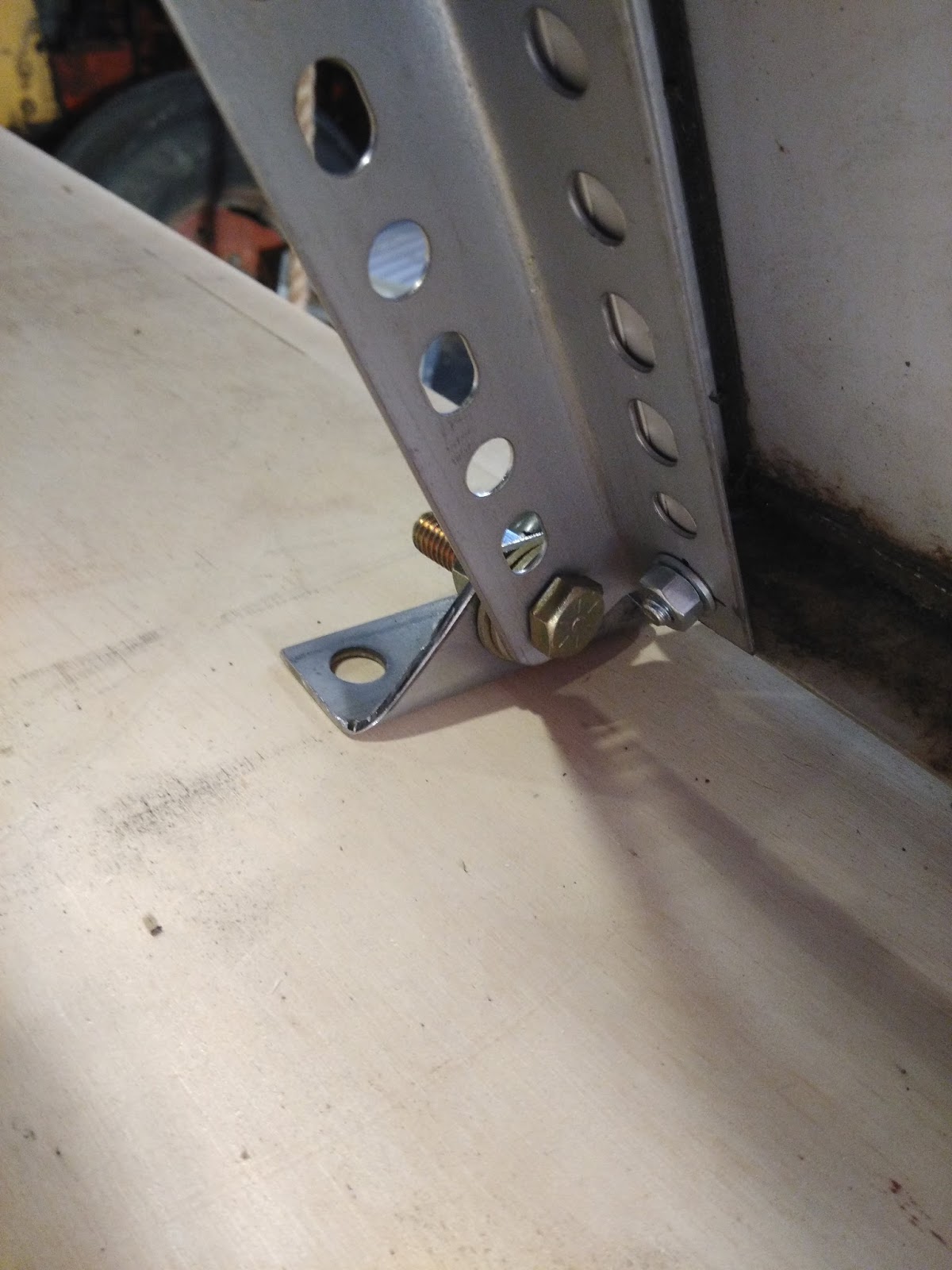
Once all the mounting feet were in place (as pictured,) I loosened all of them, applied a liberal amount of RTV, and then snugged all of them to the bus skin. The panels are installed in their proper order, now they need a mechanism to hold them upright, and to be wired into the bus's battery system.


Projects are on hold at the moment, as I'm out of country with the Unit on mission for a few weeks. I think it's about time to burn some leave, at work. 
Day 10326

Spring is here for good; the snow and the ice have melted, and the grass is turning green. As the Woolly Mammoths migrate into Canada, and the glaciers recede, spring meltwaters have started flowing down mountains into the watershed. One of these seasonal streams is flowing over one of my friend's driveways. As a new home-owner, he was less than excited to see that this is what spring brings. We talked through our options, and decided the best, easiest, most cost effective fix would be to remove the damaged drainage culvert, and leave it open.

Nakahla and I loaded up my dad's backhoe, and we departed early for the mountains. Mark lives on quite a slope, so I parked my poor half-ton truck at the bottom, unloaded the Kubota, and drove it up the rest of the way. Mark's neighbors were glad to have an alarm clock chugging up the hill at 8am on a Saturday, I'm sure. Nakahla went in to help Jess with their kids, and Mark and I surveyed the damages, made note of what was working and what wasn't, and made a rough plan for what we'd be doing. When we wrapped the chain around the first piece of 18" culvert with the tractor, I thought I was going to be coming up here for the next month to finish the project. "What have I gotten myself into?" I asked... aloud. "I'm going to be doing a lot of work on your barn!" Mark replied.


Mark's yard had one culvert flowing from the upper driveway, under 30' of yard, and under a lower driveway. We found that the upper driveway's drain was still flowing, just clogged at the inlet, which we cleared. The middle drain had separated and water wasn't flowing through it anymore, which is fine because the lower driveway's drain was collapsed anyway! We dug up the middle and bottom sections, replaced the broken bottom with the intact middle, and crafted a streambed in the middle section of driveway. To keep the lower pipe from clogging we made a small pond full of larger rocks to discourage things from flowing through.


In hindsight, we should have diverted the flow as best we could at the top, and worked from the bottom of the property up. Instead, we were working in the water most of the time. On the flip side, the water flowed where it wanted to go, and softened up the earth around it, making it easier to work. We were able to make small diversions while we worked, anyway. Amazingly, we got the project done in one weekend. Jess and Nakahla kept us fed, Mark's kids kept us entertained, the weather cooperated, and now I have an indentured servant for my next project.


At home, I reattached the backhoe to the Case tractor. It has been sitting plumbed for a few weeks, just waiting for free time and warm weather to coincide. I started the machine up, and back it up to within 6" of the backhoe. I dug the bucket into the ground, and used the dump pistons to push the tractor forward and back, while adjusting the backhoe swivel pedals left and right, to line up on the backhoe boom. I was off the machine for this, so I had large split logs under the main wheels to keep it from rolling. This went really slow, and required a bit of patience, to get two several-ton pieces of steel to line up within 1/2". Once they were close enough, I used the Hi-lift jack to lift the backhoe boom. With luck, and my dad offering a second set of hands, the pin went in without much effort. I then reinstalled my zip-tie color-coordinated hydraulic lines, and pinned the boom cylinder to the swivel tower. I reversed the pressure/relief lines on both the stick and the bucket cylinders so that pulling the levers toward you brings everything in, and pushing them away runs it all out.


A handsome dog.


If you don't have a backhoe, that whole paragraph probably sounded like Chinese. If you do have a backhoe, it probably sounded like Chinese, too. End result? I have a backhoe again. And it doesn't leak from the valve spools. I finished up the project by putting snap-rings on pins, changing the hydraulic filter, and pressure washing the greasy spots. Also, the pressure washer started after a dozen pulls, on old gasoline, after sitting for six months; when does that ever happen?


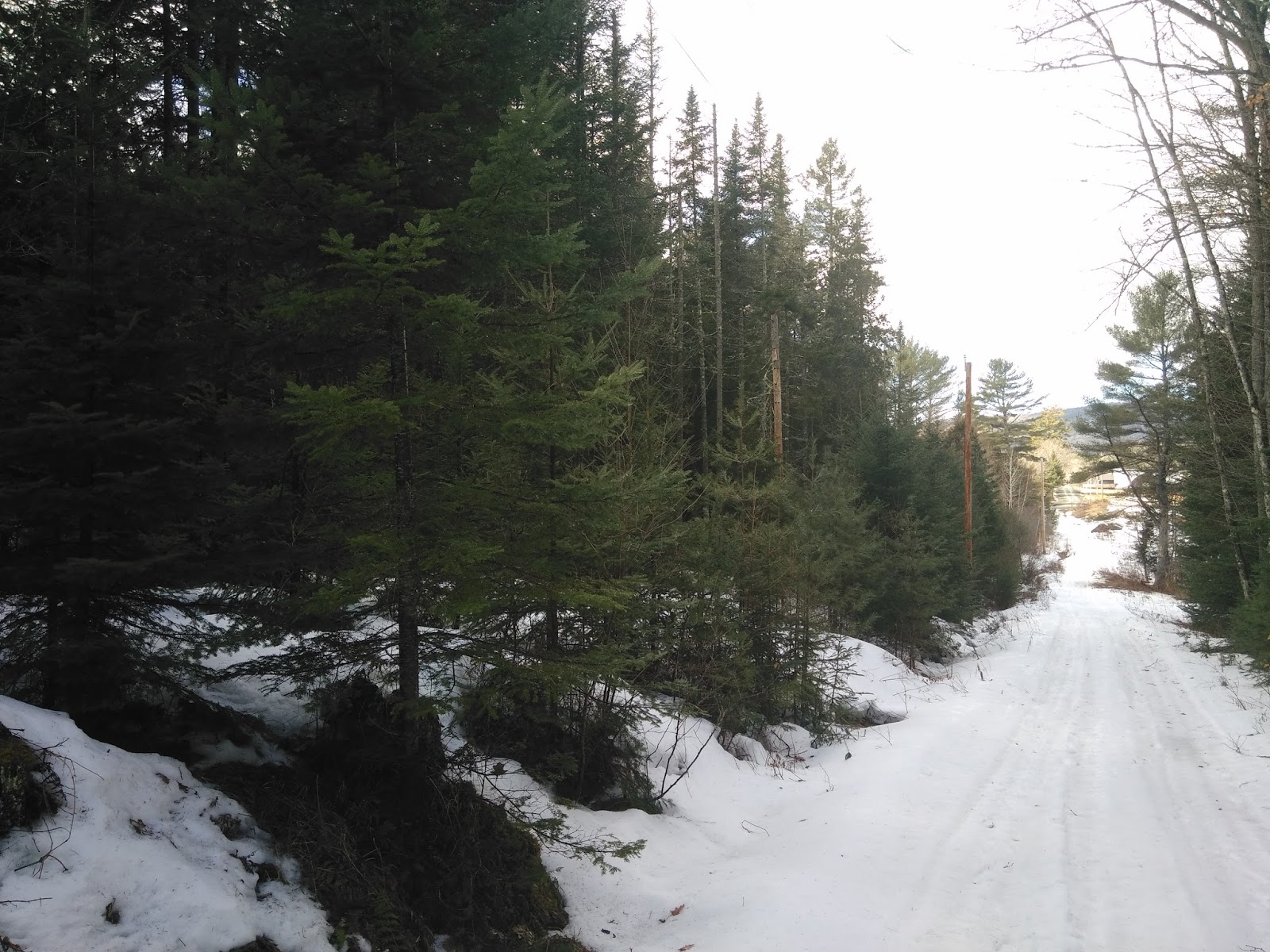
Over Easter, I toured another property up North. It had come up in my search online, and I had discarded it, but Nakahla had sent it to me again for a second look. More than ten acres, fields and woods, a stream, convenient to the highway and close to family, for a price I could afford. I thought it was under a set of transmission lines, but on second look I realized the pictures weren't matching up with the pin on Google maps.


Happy dog.


View to the North.


A bunch of nice Birch trees.


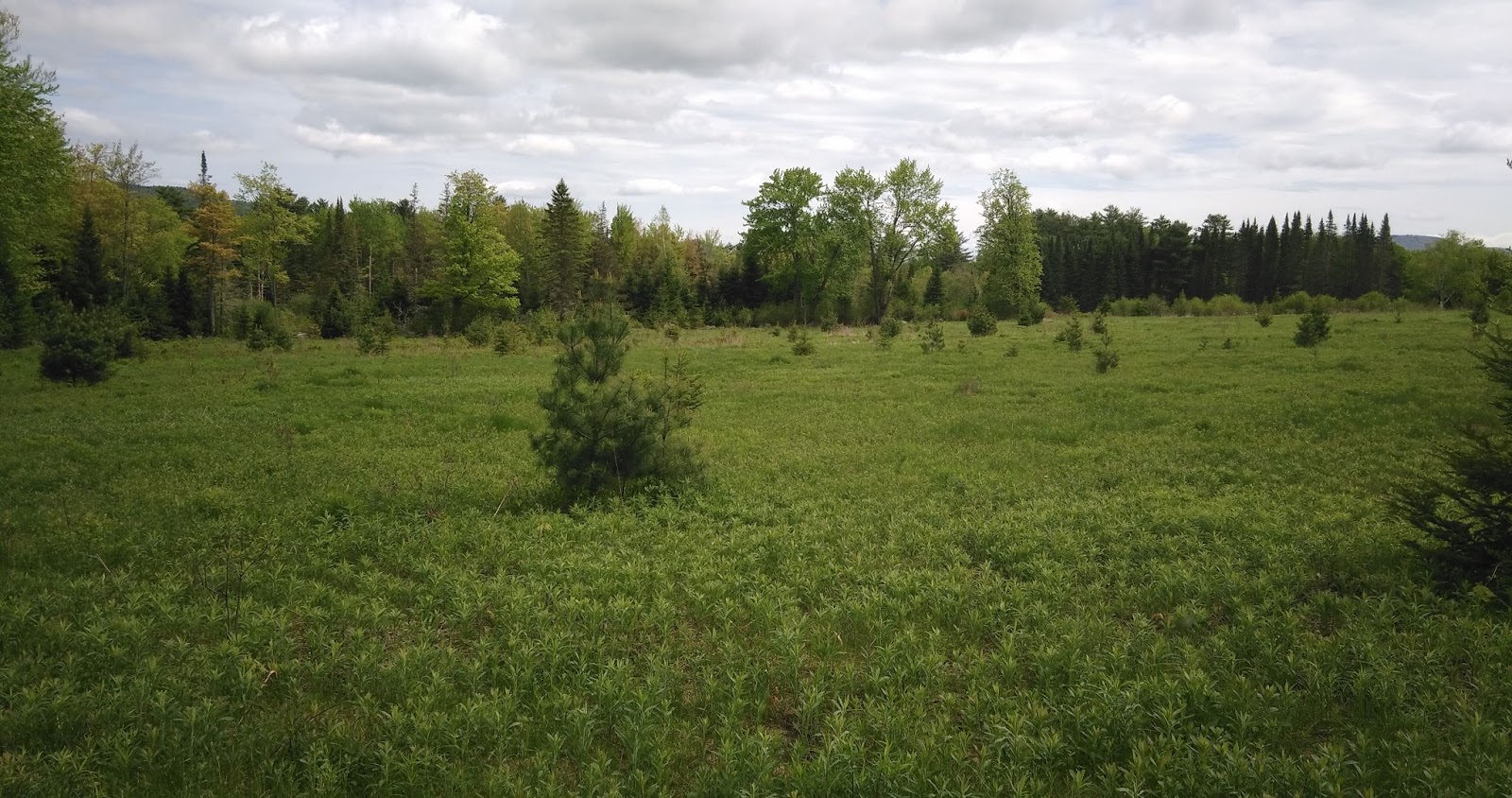
I walked it with my Dad, who approved. I came back later with my Mum and Grandfather, who both approved. Zeke liked it. I liked it! The bus will fit! I emailed my realtor and put in an offer. We'll see how this plays out.

These epic posts, with weeks of work condensed into one write-up, sure make it seem like I accomplished quite a bit in a short amount of time. I can tell you that it feels like I'm dragging my feet, and not able to work on anything when I want to!

Next up is the mounts for the solar panels on the bus roof, some small welds on my dad's tractor and mine, and an oil change on the welder. Once I have everything else in order, I'll start the big project of the dump bed install on the F350.

If the land purchase goes through, I will start getting equipment up North.

Thanks for reading! Feel free to leave a comment or send me an email.

Day 10292

The thaw is coming. The first trees are starting to bud, after a series of snowstorms brought us a second winter. My cabin fever will soon be cured by sunlight and 40 degree weather.

Over the past few weeks I have been working primarily on the backhoe, making a lot of progress on the warm days.


On a cold, sunny day, I took a torch and penetrating oil down to my stuck swivel piston bearing on the old backhoe tower. I knocked the 500lbs of steel off the blocks for easier access, and heated it for several minutes with a gas torch. Using a densely packed snowball, I cooled the bearing. After a few sequences of heating and cooling, I was getting half a turn out of the bolts to pull the bearing out. Once it started going, the stubborn bearing came out relatively easily.


Zeke was less than interested in being a sled dog, so I ended up pulling the heavy, greasy piston up to the backhoe for installation.


 Going for a walk out back was fine, though.


After a lot of cleaning, I got most of the dirt/grease/hydraulic fluid mix out of the tower. I lubricated the bearings with red axle grease (nothing special about it, just something to keep water out) and installed them with fresh bolts and lockwashers. The hydraulic lines to the swing cylinders and stabilizers were all pressure washed, and any with defects (coating worn through to metal fibers) were replaced. 


With the swing and stabilizers pinned and plumbed, as well as the engine oil changed, I cranked the machine over and tested those parts of the system. I made it a point of not touching the middle three sticks on the control tower, as they were just open ports that would have sprayed brown, murky hydraulic fluid at me!


Continuing on, I replaced all the lines leading to the backhoe, and started removing the leaky loader dump pistons so they can be repacked. I'm having trouble with the hardware, which is all (3/4 of the bolts) stuck. Now that my backhoe is repacked and leak free, the loader will be doing the leaking! The Gremlins have migrated. An old Royal Air Force trick was to place first class postage stamps on their airframes; the Gremlins would eat those instead of control wires or fuel lines. I'll have to find out what construction equipment Gremlins like to eat.


Meanwhile, on the F350...


I have to pull some Apollo 13 White-team fix to get a metal fuel tank fuel sending unit to fit a plastic fuel tank. Maybe if I do an orbital sling shot I can get the new unit into the old tank... or use a Sawzall and a lot of sealing compound...

I did get a package for the F350 last week, too.


I bit the bullet on a dump hoist for the F350. It's a Pierce 5-ton electric/hydraulic lift. Not only are they amde in the great state of Texas (with a pump that appears to be from Michigan,) but they've posted install videos on YouTube. Very helpful.


Once the backhoe rolls out of the shop, and the imminent threat of winter storms is past, I'll drop off the plow and roll the F350 into the shop for a dump kit install. I'll also be wiring in soem LED brakelights, and beefing up the existing pintle plate. Still on the search for a flatbed for the one ton.


Nakahla and I went to the Colonial craft show in Portsmouth this weekend. In addition to muskets, ceramics, and tin cookware, was this impressive model of a timber frame house in Rollinsford, with all the pieces labeled.


My dad gave me chainsaw lessons this weekend as well. I'm not too comfortable using the chainsaw yet, but getting better every time. Like any good training event, everything that could go wrong did go wrong. Pictured above is his pinched chain, and my pinched handsaw blade, both detached from their motors and handles to cut our losses. The tree settled onto one, then the other trying to free the first one. We managed to free up both using a wedge and an axe to fell the tree. The chainsaw was undamaged, and we continued with some scrawnier trees! My sawblade was severely wounded in the altercation. Flawless.


Lastly, I toured a property up north with my grandfather. Plenty of room, great location, stream going through it, a spot where I could drive the bus in, and it's in my price range. We'll see where this goes.


Day 10236

Winter's cold has slowed my pace of construction and tinkering on the bus, and the homestead vehicle collection. The panels aren't on the bus roof yet. The backhoe still sits in the barn.


I did, however, install the bench vise that aunt Zowie got me for Christmas. Thanks Zowie!

I did put a bench seat in the truck (remember I picked that up in Massachusetts in the last post?) The bucket seats were more than a little gross, and I think the mice were living in them.


With angle grinder, drill and wrench, I got the carriage bolts out of the cab and pulled the old seats. It was way more fun than you'd imagine. By that I mean it was awkward holding mechanic yoga poses, and my hands were freezing the entire time. I vacuumed the carpet. My mum came over and asked if it was the carpet or the seats that smell like cow manure... good question. This truck has fragrance.


Then the new old bench seat went in ($100 on craigslist, out of a rotten '85 F150.) I dressed it up with a worn-but-classy 1940's blanket I found on Etsy. I cut two small slits for the seatbelts to poke through. 

Etsy is a dangerous place, for the record.

I also bought a hydrometer for the bus's batteries. The cold is hurting those poor things, and it's been too cold and icy for the delicate work of installing the solar panels. Just running the bus once a week to keep the batteries charged isn't enough to keep these deep-cycles healthy; they need a good equalization, or overcharge, which the bus engine's alternator can't provide. The solar panels, however, can provide an equalization charge through the Morningstar charge controller once that system is up and running. All I want is one nice, sunny, 40' day...


The bus wouldn't start on it's own the other day; the engine would turn but the voltage and amps weren't high enough to light the glowplugs, as well. I shoveled and plowed a path down to it, and jumped it with the bed-less F350 (the ride, on the new bench seat, was quite pleasant.)

You may recall that these batteries once powered the bus. The same day I put the bench seat in I changed the truck's battery terminal lugs over to post-type, ditching the beat up clamp-on style. Without the lead adapter pieces on the battery terminals, the hood closes all the way! Hooray, less fire/electrocution hazards! I don't have any pictures of that job because I was cold.

After a full charge, and letting the voltage settle down for an hour, I used the hydrometer to check the bus battery's charge. Each of the individual T105's has 3 cells (a battery cell is ~2 volts.) The battery acid in a fully charged battery has a different specific gravity than that of an uncharged battery. With the hydrometer I found that two of my batteries were scoring in the 85% capacity range, and two were in the 70% range. They need an equalization, but it's going to have to wait until warmer weather and free time comes around simultaneously. I didn't take any pictures because I was working with battery acid... and I was cold.

In the meantime, I've been reading... a lot. I read Gaining Ground, by a disciple/contemporary of Joel Salatin's; Forrest Pritchard. After his parents make a profit of $18.16 off several truckloads of corn and soybeans, Forrest returns from college with the mission of saving his family's farm. Very good read with a lot of humor! I also read through the "Wranglestar" family's book, Modern Homesteading. I've been a big fan of Cody's videos on YouTube, and enjoyed this summary of the family's journey that was mostly stitched together by Mrs. Wranglestar. Now I'm onto Everything I Want to do is Illegal, by the illustrious Joel Salatin. I got to see him this weekend, at a National Organic Farmer's of America conference. As the keynote speaker he gave a talk with many of the themes of Folks, This Ain't Normal. He was preaching to the choir, but I enjoyed it very much.

The land search continues, and I've elected to set my sights farther North, for various reasons.

Day 10207

I struck gold on craigslist; six old Siemens 75 watt solar panels. Not only were these made in the glorious USA, but they have a reputation for durability. Like many things on craigslist, their origins are shrouded in mystery, but I will put them to good use on the roof of the bus.


The gentlemen I bought them from helped me cut the six-wide frame into three sets of two panels, which I loaded into the truck bed carefully with cardboard and blankets to keep them from harm on the ride home. Additionally, I found a bench seat that would fit the F350 (the bucket seats are pretty gross) which was on the way home from southern Massachusetts.

While the Powerstroke diesel in the nose is very good at providing the bulk charge to the battery bank, the absorption charge which completely charges a battery is best done by a tapering power source like solar panels. I have been reading up on HandyBob's blog again for more insight into crafting a solar power system (his writing was indispensable to the design of my electrical system thus far.) I also bought a Morningstar TS-45 charge controller, because HandyBob said so, which essentially feeds the batteries palatable electricity from the panels. I also bought a hydrometer to check the specific gravity of the battery's fluid, which is the best way of determining the health of the batteries. I really should have acquired one a while ago. More on these two pieces of gear in future posts.

There is a surprising amount of geometry involved in setting up a solar system. The goal will be to get all six of these panels on the roof, pointed true south for maximum sun exposure, angled for the winter sun at our latitude, and out of any shadows created by trees or the chimney. The exact location of the panels is still somewhat up in the air, but I think I'm going to put them above the front door, on the passenger side, running back to where the chimney comes out. I will have to accept an evening shadow from the chimney with this configuration, but it minimizes length of cable needed to reach the battery bank, avoiding excessive voltage drop (very important.) We'll see what happens.


For elbow room, and access to a lot of 110v amps, I elected to do this project in the big cold barn, instead of a nice warm bus. The hardware holding the panels to the thick steel frame was very corroded, so I cut the temper-resistant bolt heads off with the angle grinder (clearly not tamper-proof, or I wouldn't have been able to get them.) A hammer and punch knocked the bolts loose, then I picked the frame pieces up off the bolts, which had to be sliced in half again to remove from the thin aluminum frame of the panels.


The aluminum frames had also corroded where they were bolted in. The brown and orange material is rust from the steel frame. The off-white powder is aluminum oxide. Corrosion... gross.


The panels, standing tall on their own, free of the nasty, heavy frame. I neglected to mention earlier that all the wiring linking  these panels together was still intact, and of a proper gauge for my application. More on that in the future (parts are on order.)

With the panels separated, I continued to clean them up, and think of ways I could mount them to the bus. This took some time; I turned to Google and saw a lot of things... some good ideas using perforated angle... and some horrible monstrosities using perforated angle. I personally think perforated steel angle is ugly (and not the good kind of ugly like the A-10 Warthog, Black Hawk helicopter, and all of my vehicles) so I want to minimize use in the final design. 


The panels need to be able to pivot, and be easily adjustable, so that they can stare up at the summer sun, 20 degrees from horizontal, or out at the winter sun, 66 degrees from horizontal. (your latitude +/- Earth's tilt) To do this I am going to use perforated angle as both the interface between the mounts and the panel, as well as the adjustable piece of the mounting system. I bought the metal I needed, and cut my first prototype pieces with an angle grinder.


The mount feet are 1-1/2 x 1-1/2 12GA steel angle. The mount rails are 2' chunks of 1-1/4 x 1-1/4 18GA steel angle, with the bottom corner filed round to pivot freely.


Using a 4', 1/4" steel rod roughly bent to shape while cold with a vise, I can make a triangle to secure the panel upright. The rod acts as a spring, pushing out into the holes of the perforated angle, and could be easily adjusted for different seasons. The bottom of the "V" would have a bushing, and go into another mount foot. The angle would also be different on the curved roof of the bus; once the pivot feet are all mounted in line at a good spot on the bus roof, I could come through and position the support rod's mount so that it could adjust between 20 and 66 degrees, and hopefully some kind of stowed position.


With a functioning prototype, I went to work cutting out feet and rails from stock.


In total, I made 18 feet (which is overkill, I'll have extras) and six pairs of mirrored rails. I left Tractor Supply with another $15 bag of 1/4x20 nuts and bolts. Now for the tedious task of removing flashing and burrs with a file... I really ought to get a bench grinder...